• Skip to primary navigation
  • Skip to main content
  • Skip to primary sidebar
  • About
  • Contact
  • Advertise

Milwaukee Community Journal

  • News
    • Local News
    • National
    • World
    • Political
  • Men Building Men
  • Lifestyle
    • Arts & Entertainment
    • Fashion
    • Culture
    • Religion
  • Economy
    • Small Business
    • Money
    • Entrepreneurship
  • Health
    • Family
    • Relationships
  • Education
  • Jobs
    • Housing
  • Scholarship Fund
You are here: Home / Archives for Election Watch

Election Watch

Wisconsin’s Democratic primary for governor has changed a lot since January — and not much at all

July 27, 2026 By MKE Community Journal Leave a Comment

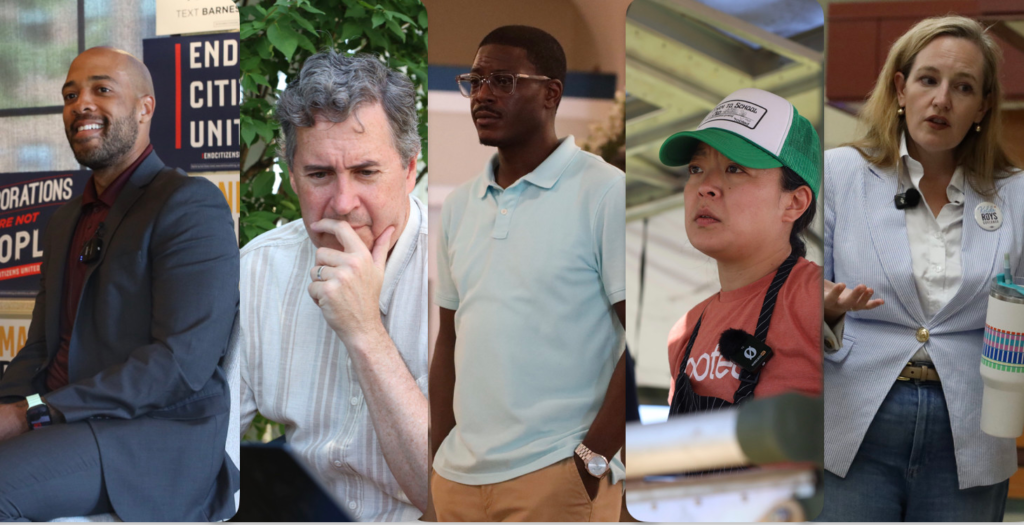
Democratic candidates for governor include, from left, former Lt. Gov. Mandela Barnes, former Department of Administration Secretary Joel Brennan, Milwaukee County Executive David Crowley, Madison state Rep. Francesca Hong and Madison state Sen. Kelda Roys. (Photos by Brittany Carloni / Wisconsin Watch)

by Brittany Carloni / Wisconsin Watch, Wisconsin Watch
July 27, 2026

The Democratic primary for governor of Wisconsin has changed both dramatically and barely at all since the start of this year.

The size of the field, which remained stagnant at seven major candidates for months, shifted rapidly in the span of 10 days in July that included both the exit of Lt. Gov. Sara Rodriguez from the race after she revealed problems with her campaign finance reports and the reentry of Milwaukee County Executive David Crowley, who secured a historically rare endorsement from Gov. Tony Evers.

As of Sunday, the race includes former Lt. Gov. Mandela Barnes, former Department of Administration Secretary Joel Brennan, Crowley, Madison state Rep. Francesca Hong and Madison state Sen. Kelda Roys.

Here is what hasn’t changed: Hong, a self-described democratic socialist, led her opponents in the third consecutive Marquette University Law School poll released last week, which was conducted prior to Rodriguez’s exit from the race. Internal polling released by Barnes and Crowley’s campaigns also showed Hong in front.

A fractured field means support continues to be spread out across the remaining five candidates and could result in a winner on primary Election Day with far less than 50% of the vote. Meanwhile, Republicans have coalesced around likely nominee U.S. Rep. Tom Tiffany for months.

“Hong could certainly win the nomination with 35 to 40% of the vote,” said Anthony Chergosky, an associate professor of political science at the University of Wisconsin-La Crosse. “All available evidence indicates that Hong is below 50% of the vote, but she doesn’t even need 50% of the vote if the field remains so fragmented and divided.”

At the same time, the percentage of undecided voters continues to be higher than those who have selected any specific candidate. The Marquette poll found nearly half of registered voters surveyed in mid-July were undecided.

Wisconsin Watch traveled to forums, farm tours and meet-and-greets around the state as the five remaining candidates have continued to lay out their vision to voters and explain why they are best suited to lead Wisconsin.


The stakes of the race are high. Democrats see 2026 as an opportunity to win control of the Capitol for the first time since 2010, which could result in dramatic new progressive legislation. After Republicans won the governor’s office and majorities in the Senate and the Assembly in 2010, they used that power to dismantle public sector unions, increase pension and health insurance contributions for public employees, cut taxes, freeze UW tuition, restrict abortion, permit concealed carry of firearms, end the state’s land conservation program and enact gerrymandered legislative maps that protected their majority from a Democratic wave in 2018.

It leaves a lot for voters to digest as in-person early voting begins Tuesday and two weeks remain before the partisan primary on Aug. 11. Two key moments this week could reshape the race — a debate hosted by WISN on Tuesday evening and a new Marquette Law School Poll of the current field expected to be released on Wednesday.

Barnes takes aim at political establishment
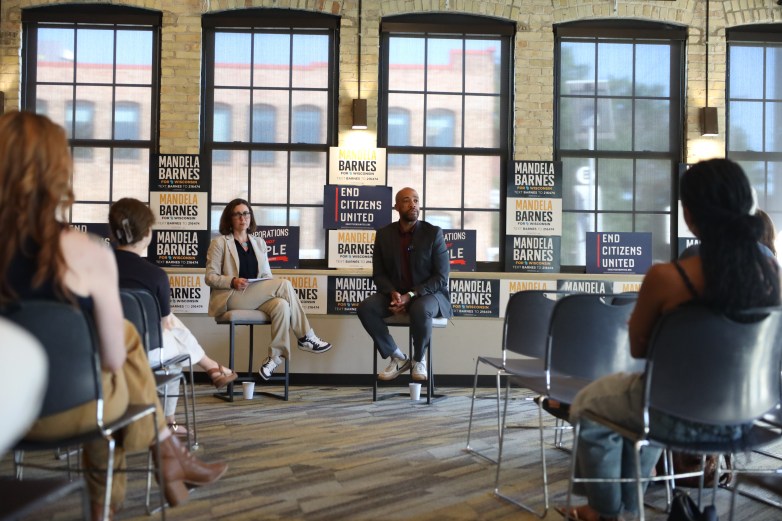
People sit facing two people indoors. Campaign signs reading
Mandela Barnes, a Democratic candidate for governor, is seen with End Citizens United President Tiffany Muller at a town hall about money in politics on July 14, 2026. Barnes, the former lieutenant governor who lost a close U.S. Senate race in 2022, is one of five candidates running for an open seat after Gov. Tony Evers chose not to seek reelection. (Brittany Carloni / Wisconsin Watch)

The same day the Wisconsin Elections Commission determined tech businessman Elon Musk likely broke state election laws during the 2025 state Supreme Court race, former Lt. Gov. Mandela Barnes slammed the influence of money in politics at a town hall with End Citizens United, a political group that quickly endorsed him upon his entry in the governor’s race in December.

Wisconsinites rejected Musk’s financial influence last year and must continue to fight against a “rigged system” that doesn’t support policies for working people, like raising the minimum wage, Barnes told the small group gathered at the Goodman Community Center in Madison.

“These are the same industries that are making money hand over fist, the same people in industries that continue to make it hard for folks to get paid,” Barnes said. “You talk about people working harder and harder but life also getting harder and harder. It’s more difficult to get into the middle class. It’s more difficult to be able to purchase that first home. It’s more difficult to be able to even think about the American Dream now.”

Barnes grew up in Milwaukee with a mother as a public school teacher and a father who belonged to the United Auto Workers union. He is a former organizer who served two terms in the state Assembly, ran for and lost a state Senate seat and was elected lieutenant governor during the 2018 blue wave. He has led a voter turnout organization and a clean energy advocacy group, but hasn’t run any large organizations, which opponents have highlighted as a weakness for someone seeking to be the state’s chief executive.

In 2022 he won the Democratic nomination for U.S. Senate after opponents dropped out ahead of the primary, but narrowly lost to Republican U.S. Sen. Ron Johnson. While the race has driven his name recognition in the gubernatorial primary, that 26,000-vote defeat still eats at him, he told guests at the Wisconsin Democratic Convention in June.

The loss has opened him to criticism from other Democrats who have questioned whether he can win in a year when the party is striving for a trifecta in the governor’s office and the Legislature.

While he trails in the polls behind Hong, Barnes insists he remains the most battle-tested candidate to take on obstacles for Democrats after the primary. The recent Marquette poll shows only Barnes leading in head-to-head matchups against Tiffany among the remaining candidates in the race, although last week’s poll did not include Crowley.

Barnes has campaigned on what he calls “The Wisconsin Way,” a policy agenda that includes raising taxes on the rich, expanding BadgerCare, passing universal child care and freezing utility rates, though some experts question whether Barnes would have the legal authority to freeze rates as governor.

At a Democratic forum in Belmont, Barnes criticized the political moves that led Crowley to reenter the governor’s race with Evers’ endorsement. It’s another example of a system that leaves people frustrated with politics, he said in a clip shared on social media.

“The only people who win when we continue to play these insider politics games are corporations and special interests,” he said. “We deserve so much more.”

Brennan brings state government experience

Three people stand next to a cornfield under a partly cloudy sky. One person gestures while the others look on.
Joel Brennan, right in white shirt, a Democratic candidate for governor, campaigns at a farm in East Troy, Wis., on July 2, 2026. Brennan spoke with research agronomist Jim Stute (green shirt), who owns the farm, and Chuck Anderas (blue shirt), the policy director at Michael Fields Agricultural Institute. (Brittany Carloni / Wisconsin Watch)

Joel Brennan arrived at an East Troy farm ready to listen.

Brennan nodded as Jim Stute, a research agronomist, explained how precipitation levels have changed on the property he has lived on for nearly three decades. Brennan leaned against a headless scarecrow in a white lab suit among the neat rows of research crops as Stute described his tactics to scare away sandhill cranes.

It’s a window into how Brennan, a longtime city dweller who grew up in Brookfield and lives in Milwaukee, has approached his campaign for governor.

“It’s got to be about learning and listening. If we’re going to get stuff done, it has to be around … data-driven decisions and personal stories,” Brennan explained. “For me it is about how do I get out here and do this, how do I learn from people who have been doing it, what are the successes, what are the ways the state’s been involved, and what’s the opportunity for us?”

Brennan is unabashedly running as a moderate Democrat, often aligning himself with the Evers administration that he helped lead as the secretary of the Department of Administration. He highlights his willingness to continue working across the aisle to get things done for Wisconsinites.

Like many of Brennan’s primary opponents, his campaign has focused on ways to make life more affordable in Wisconsin, such as expanding Medicaid and providing a public option for BadgerCare. But his ideas have often differed from some of the large-scale policies of his primary opponents. While the other Democrats have backed universal child care, Brennan has instead favored tax credits for child care businesses, caps on out-of-pocket costs for families and expanding eligibility for the existing Wisconsin Shares program.

He entered the race in mid-December and has leaned on his career experience holding executive-level roles in businesses and nonprofits, including serving as CEO of Discovery World and president of the Greater Milwaukee Foundation. In 2018, Evers tapped Brennan to lead the DOA, the top state executive agency tasked with overseeing financial management of state agencies and helping the governor draft the biennial budget. Brennan left that position in 2022.

Brennan is the only one of the remaining candidates who has not held elected office before, which has limited his name recognition. Though he was the first Democratic candidate to launch a campaign ad in June, he only mustered 5% support in last week’s Marquette poll.

Still, he has tried to find ways to push through the crowd, including questioning the electability of front-runners or his primary opponents’ leadership decisions. He was the first to attack Rodriguez with pointed questions after she fired her campaign manager over inaccuracies in her financial reports and released an ad last week criticizing Hong, Barnes and Crowley as unelectable in a general election. The ad, however, received pushback from Black Democrats, who called the spot racist for specifically highlighting candidates of color. It left out mention of Roys, who is white like Brennan.

Brennan insists his executive experience gives him an edge over the candidates with legislative experience who “don’t have defined duties.”

“That’s what I’m going to keep leaning into,” Brennan said. “That, plus listening and learning, I think, gets you to a point where people can see me doing the job, know that I could win and could be effective as governor. Those are the ingredients that get me to where I need to get to.”

Crowley returns with Evers’ endorsement
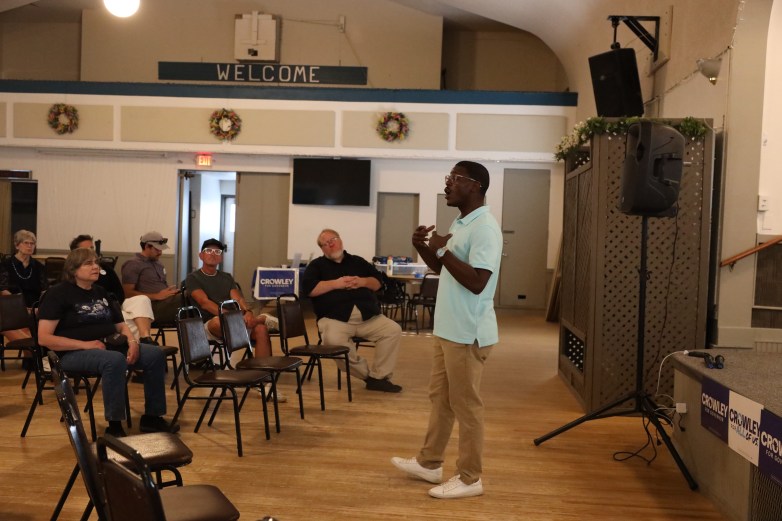
A person stands near a small seated audience in a room with a hardwood floor and a welcome sign above a door. Campaign signs reading
David Crowley, a Democratic candidate for governor, speaks to guests at a meet-and-greet at the Concordia Ballroom in La Crosse, Wis., on July 23, 2026. Crowley, who dropped out of the race in early July, reentered on July 18 with an endorsement from Gov. Tony Evers. (Brittany Carloni / Wisconsin Watch)

The first question for Milwaukee County Executive David Crowley from a smattering of people gathered at the Concordia Ballroom in La Crosse was about why he dropped out of the governor’s race in early July.

“It’s a long story,” Crowley said. He explained he initially chose to leave the race based on the numbers and campaign ad buy announcements that seemed to show Rodriguez with the best path forward, but more information came out about Rodriguez’s financial position that showed it was not the case.

Crowley restarted his campaign on July 18. While Crowley acknowledged he may be the “double Dutch candidate” in the race, he told the group in La Crosse he feels a momentum propelling his campaign that was not there before.

The most significant boost came from Evers, who endorsed Crowley on July 18 over the remaining candidates who served in his administration. Evers in a statement described Crowley as “the right candidate for the people of Wisconsin.”

“He’s not just a candidate who can win in November,” Evers said. “But he’s the kind of person who cares about doing the job right, he has the experience to make tough decisions, and he’s proven he can work together with others to get good things done.”

Crowley, at 40, is both the youngest and first Black person to serve as Milwaukee County executive, the job that oversees the most populous county in Wisconsin. It’s a role previously held by former Republican Gov. Scott Walker. “I’m not like him, though,” Crowley said with a chuckle to a guest in La Crosse.

Crowley grew up in Milwaukee and navigated challenging early years as his parents struggled with mental health and addiction and his family faced evictions. He credits public schools with his path to success and eventually became a community organizer.

His entry into politics first began with work on former U.S. Sen. Russ Feingold’s campaign. Crowley was first elected to office in 2016 when he ran for state Assembly. He served two terms and left the Legislature in 2020 to run for Milwaukee County executive.

Crowley tells audiences at campaign events how, as county executive, he has not shied away from working with anyone, including lawmakers across the aisle, to improve the lives of people in Milwaukee County. In La Crosse, he told the group about his efforts in passing the 2023 shared revenue law that has helped Milwaukee County pay off debts incurred from the pension scandal in the early 2000s, although Crowley acknowledged the law did not solve all municipal funding problems across the state.

Crowley has focused his campaign on an affordability plan referred to as the “Badger Basics,” which includes proposals such as building more housing, creating a public option for BadgerCare and easing child care costs for families with a child under age 5 by capping their costs at 7% of their household income.

The key question for Crowley’s campaign is whether any momentum following his reentry into the race can actually push Crowley to the front of the field with just two weeks left to go.

The new Marquette poll this week will provide a window into if his support has grown among registered voters, but in recent days, Crowley has also had to field questions about profane social media posts on an account he said he once shared with others. Crowley’s campaign told news outlets that although he had access to the account, he did not write any of the posts.

Crowley said Evers’ endorsement shows the governor, whose job performance remains favorable among Wisconsin voters, believes in Crowley’s judgment.

“I think indirectly, people are wondering, ‘OK, who the hell is this dude, and why did Governor Evers pick him?’” Crowley said. “So, people are showing up. They’re paying attention to our social media posts, and they’re coming out to volunteer and donating their hard-earned money to support this campaign because they trust his judgment.”

Hong rides momentum into final weeks of primary campaign 
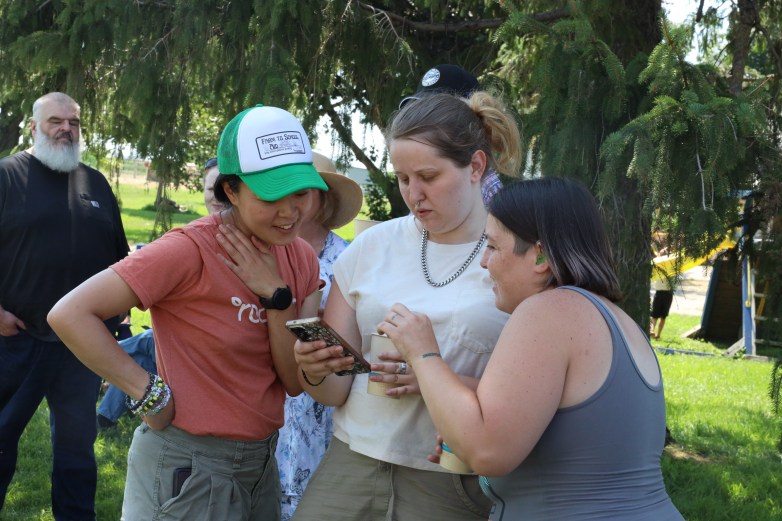
Three people stand together outdoors looking at a smartphone while others gather under trees in the background.
Francesca Hong, a Democratic candidate for governor (green hat), visits the Wegmueller farm in Monroe, Wis., on July 12, 2026. Hong, a Madison state representative, is a democratic socialist and has gained national attention for her campaign as democratic socialists have won big races in other states. (Brittany Carloni / Wisconsin Watch)

Francesca Hong diced tomatoes for pico de gallo as she told guests at Dan Wegmueller’s farm in Monroe about the top question she hears on the campaign trail.

Why is she a democratic socialist?

“It’s less about the labels and more about the solutions,” Hong explained as her knife hit the cutting board, a familiar task for the chef and former restaurant owner. “When we are focusing on local, on the means of taking care of people and lowering costs, that has to mean being less reliant on industry. Right now, our community is being dominated by billionaires and mega corporations not paying their fair share, and then deciding a lot of the pricing and the way that we live our lives.”

Hong, a 37-year-old state representative from deep-blue Madison, has emerged as a top contender in Wisconsin’s Democratic gubernatorial primary. Her surprising rise comes as democratic socialists are winning primaries across the country and rejecting establishment policies. Hong has led in three Marquette polls since October and finished second behind Rodriguez in the WisPolitics straw poll at the Wisconsin Democratic Convention in June.

If Hong wins the nomination, the key question for Democrats in swing-state Wisconsin is whether her policies appeal to voters across the state. The Marquette poll last week showed more registered voters have an unfavorable view of the democratic socialist label than a favorable one.

Republicans appear to be rooting for her nomination. A recent ad from the Republican Governors Association ominously casts her as being too liberal, opposed to President Donald Trump and supportive of abolishing Immigration and Customs Enforcement — all statements that could entice Democrats to vote for her in the primary.

Hong has had to answer questions about controversial democratic socialist views, such as her past social media posts in support of defunding and abolishing the police. She told radio station WTMJ in July that she does not believe police funding should go away. At the same time, Hong has faced backlash from Republicans for her statement that described the fatal shooting of Corey Ruiz in Madison as “an execution.”

Hong also has had to fend off questions about appearing on a fundraising live stream with Hasan Piker, the controversial political commentator and streamer, who has been criticized for antisemitic comments. Hong told the Milwaukee Journal Sentinel that she disagrees with some of Piker’s comments, but said candidates should not give up opportunities to address large audiences.

Hong, a single mother who was elected to the Assembly in 2020, has leaned on her service industry background and economic policy proposals, including universal child care and a moratorium on data center construction, to connect with voters.

In the final weeks, Hong said she plans to continue to show up in communities not expecting to see a candidate and engage in one-to-one conversations to drive curiosity about her vision and policies. People underestimate the extent that policy matters more than labels and existing political boundaries, Hong said.

“I’m lucky that I get to say and show up as a chef, a mom, a renter, a service industry worker,” Hong said. “That from worker to worker we’ve got to talk about how we’ve got to fix this.”

Roys has teachers union endorsement, campaign experience
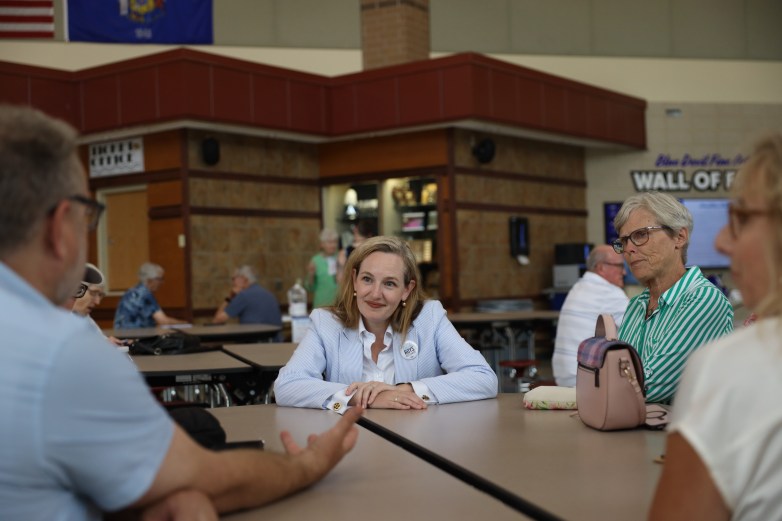
People sit around a table in a cafeteria setting. A person wearing a button reading
Kelda Roys, a Democratic candidate for governor (blue blazer), speaks at a rural issues forum at Evansville High School in Evansville, Wis., on July 9, 2026. Roys, a Madison state senator, is one of five candidates running for an open seat after Gov. Tony Evers chose not to seek reelection. (Brittany Carloni / Wisconsin Watch)

Kelda Roys, sitting center stage in Evansville High School’s auditorium, eagerly chose a bucket brimming with education questions as the first category of the night during a forum on rural issues in early July. Just three candidates — Roys, Hong and Republican Andy Manske — participated.

It was an obvious move for the Madison state senator, who won the endorsement of Wisconsin’s largest teachers union and bills herself as the “education candidate” in this year’s Democratic primary.

Roys used the question — explain your position on separation of church and state regarding public schools in Wisconsin — to share her broader vision for public education in the state.

“What my kids are getting in our public schools is not the same as what my sisters and I got, and it’s not OK with me,” Roys told the crowd. “A huge part of that reason is because we are diverting public resources into private unaccountable vouchers, many of them religious in nature. So, as governor, I will fully fund our public schools.”

Gubernatorial forums are familiar spaces for Roys. She ran for governor in 2018, when 10 candidates competed in the Democratic primary for the chance to unseat then-Republican Gov. Scott Walker. Roys finished third far behind Evers, who defeated Walker that November.

Before that, she served two terms in the Assembly from 2009 through 2013, which overlapped with the early years of the Republican trifecta control of state government and the passage of Act 10. Roys led protests against the law that dismantled collective bargaining rights for most public employees while serving as the Assembly’s Democratic caucus chair.

In 2012, she ran for Congress and lost the Democratic primary to now-U.S. Rep. Mark Pocan. Roys returned to the Legislature when she was elected to the state Senate in 2020 after winning a seven-candidate Democratic primary on Madison’s west side and ran unopposed in 2024. She is also an attorney and a real estate agent.

Roys has focused her campaign on funding public schools, but also lowering costs and raising wages. Her policies include plans to open the state’s insurance plan to all Wisconsinites to decrease the cost of health insurance. She also proposes universal access to Wisconsin Shares, the state’s child care subsidy program for low-income families, with costs capped at 7% of parents’ income per child. The state would fund its portion of the costs through legalizing marijuana. “You’re going to be able to get baked for babies,” she said to laughs in Evansville.

She is quick at campaign events to describe the Trump administration as a “dangerous authoritarian regime,” while promising to safeguard Wisconsinites and their rights from attacks by the federal government.

Roys, though, has not made inroads in polling over the course of the primary, and last week’s Marquette poll shows her at the bottom of the pack among registered voters with support at just 2%.

Still, Wisconsin needs an experienced leader in this moment when Democratic control is on the line, and her experience in the Legislature makes her best suited for the job, she said.

“For over 20 years I have been turning progressive ideas into law in the toughest of political environments, and that is the kind of experience and deliverables that we should expect from our next governor,” Roys said. “Not just somebody with good ideas, because we’ve got six (now five) great Democrats running … but you’ve got to be able to turn them into law.”

This article first appeared on Wisconsin Watch and is republished here under a Creative Commons Attribution-NoDerivatives 4.0 International License.

Filed Under: Election Watch, Political

ElectionWatch2025 – THE RESULTS!

April 4, 2025 By MKE Community Journal Leave a Comment

Filed Under: Election Watch

Wisconsin Voters Reject Musk-Backed Supreme Court Bid, Elect Liberal Judge Susan Crawford

April 4, 2025 By MKE Community Journal Leave a Comment

By Stacy M. Brown
BlackPressUSA.com Senior National Correspondent

Wisconsin voters delivered a sharp rebuke to billionaire Elon Musk on Tuesday, electing liberal Judge Susan Crawford to the state’s Supreme Court despite a record-breaking flood of cash and campaigning from Musk, who backed her conservative opponent, Judge Brad Schimel. Crawford’s victory ensures a continued 4–3 liberal majority on the state’s high court and signals growing pushback to Musk’s rising political influence. With nearly all votes counted, Crawford held a commanding lead of about nine percentage points, defying $25 million in total spending tied to Musk and his network of political action committees. “Today, Wisconsinites fended off an unprecedented attack on our democracy, our fair elections, and our Supreme Court,” Crawford said in her victory speech Tuesday night. “Wisconsin stood up and roared, saying that justice does not have a price. Our courts are not for sale.”

Musk personally campaigned in Wisconsin, appearing at rallies and photo ops—including one where he wore a cheesehead hat—as he sought to frame the race as part of a broader campaign to reshape the federal government and state courts. His involvement appeared to energize Democratic voters and galvanize turnout, with early data showing exceptionally high participation for an off-year spring election. The race drew national attention not only because of its record-shattering cost but also due to the implications it holds for abortion rights, labor protections, and congressional redistricting. The Wisconsin Supreme Court is expected to rule on several pivotal issues in the coming months, including the legality of the GOP-drawn congressional maps that have helped Republicans win six of the state’s eight House seats, despite Wisconsin being evenly split politically. Democratic leaders had long argued that a Crawford victory could create more competitive districts. House Minority Leader Hakeem Jeffries of New York recently noted the opportunity to flip one or two Republican-held seats in the state if the court redraws the maps.

Republicans and Musk attempted to make that argument the centerpiece of their campaign against Crawford, warning of activist overreach. Musk’s super PAC reportedly funded a $11.5 million ground operation, and another group with ties to him spent $7.7 million on TV ads, according to media tracking firm AdImpact. In addition to massive ad buys, Musk’s efforts offered Wisconsinites financial incentives to oppose so-called activist judges. His super PAC offered $100 for signing petitions and $50 for posting photos outside polling places—tactics that raised concerns about voter influence and legality. But those tactics appeared to backfire. “There’s an insane situation going on with the Trump administration, and it feels like Elon Musk is trying to buy votes,” said Kenneth Gifford, a 22-year-old Milwaukee college student after casting his ballot. “I want an actual, respectable democracy.”

Democrats seized on Musk’s presence as a galvanizing force. “People do not want to see Elon Musk buying election after election after election,” Wisconsin Democratic Party Chair Ben Wikler said ahead of the vote. “If it works here, he’s going to do it all over the country.” Former President Barack Obama took to X (formerly Twitter) to congratulate Crawford and the people of Wisconsin “for electing a judge who believes in the rule of law and protecting our freedoms.” Illinois Governor J.B. Pritzker, who also donated to Crawford’s campaign, didn’t mince words in his post: “Elon Musk is not good at this.” Crawford, 60, will serve a 10-year term in court. Her win adds to a string of recent Democratic victories across the country, including state legislative races in Iowa and Pennsylvania and the defeat of four Republican-backed ballot measures in Louisiana. While Republicans maintained their grip on two congressional seats in Florida on Tuesday, Crawford’s win could signal that Musk’s deep pockets and increasing alignment with Donald Trump are igniting more opposition than support.

Filed Under: Election Watch, Political Tagged With: Abortion Rights, activist judges, Barack Obama, Brad Schimel, campaign spending, congressional maps, democracy, Democratic victories, Donald Trump, Elon Musk, fair elections, Florida, GOP, Hakeem Jeffries, House Minority Leader, Iowa, J.B. Pritzker, labor protections, liberal majority, Louisiana, Pennsylvania, Political Influence, redistricting, Super PAC, Supreme Court, Susan Crawford, voter influence, voters, Wisconsin

Photographic indentification for voting

March 27, 2025 By MKE Community Journal Leave a Comment

On ballots this spring, voters will be asked “shall section 1m of article III of the constitution be created to require that voters present valid photographic identification verifying their identity in order to vote in any election, subject to exceptions which may be established by law?” 

 If approved, the state Constitution would be changed to include the provision that “no qualified elector may cast a ballot in any election unless the elector presents valid photographic identification that verifies the elector’s identity and that is issued by this state, the federal government, a federally recognized American Indian tribe or band in this state, or a college or university in this state.” 

The provision would give the Legislature the authority to determine which types of ID qualify as acceptable. 

Current law includes state issued driver’s licenses and photo IDs, U.S. Passports, military IDs and unexpired university IDs (expired student IDs are allowed if proof of current enrollment such as a tuition receipt or course schedule is provided). 

The MCJ recommends to: VOTE NO!

Democrats say it’s unnecessary to amend the constitution to add something that’s already in state law and accuse Republicans of including the referendum on the ballot in this election in an effort to increase Republican turnout in the contested races for state Supreme Court and superintendent of schools. 

Filed Under: Election Watch

ElectionWatch2025 – The MCJ Endorses…

March 27, 2025 By MKE Community Journal Leave a Comment

For information about Brittany Kinser, the MCJ recommends you read the front page artice on her and her opponent, incument DPI Superintendent Jill Underly, that ran in the February 12, 2025 edition of the newspaper. You can go to our website, milwaukeecommunityjournal.com and go to our archives section and click on the aforementioned date. You can also get a copy of the Feb. 12 edition at our offices, located at 3612 N. Martin Luther King Drive. Our office hours are 10 a.m. to 4:30 p.m., Monday thru Thursday. We’re closed on Friday. For information about Crawford, go to her website: www.crawfordforwi.com/vote

GO HERE to view the April 1st election sample ballot

Filed Under: Election Watch, Political

Where do we go from here?

November 21, 2024 By MKE Community Journal Leave a Comment

Presidential candidate Kamala Harris in Milwaukee with Minnesota Gov. and Vice Presidential candidate Tim Walz in Milwaukee last August campaigning. Photo courtesy of C-Span


OPINION by Ron Reynolds, courtesy of NNPA/blackpressusa.com

 As the dust settles on this election, we find ourselves at a crossroads. Vice President Kamala Harris has lost her bid for the presidency, and for the first time in years, Republicans control the House, the Senate, and the White House. For many of us who have been fighting for equity, opportunity, and justice, it feels like the ground has shifted under our feet. 

The dreams we nurtured, the policies we fought for, and the progress we celebrated now face new and daunting challenges. But in the midst of this loss, I am reminded that true change has never come easy. It has come through our resilience, our determination, and our commitment to the ideals we hold dear. 

The question we face now is, “Where do we go from here?” 

Our task is not to retreat or to abandon our vision. Our task is to refocus, re-energize, and recommit to the values that brought us to this fight in the first place. As Democrats, as progressives, and as Americans, we cannot afford to look at this election as the end. 

We are the voice of millions who still long for justice, healthcare, and education that empowers rather than excludes. Every loss must sharpen our resolve, not weaken it. This is the time for reflection and a recommitment to standing with the people left behind, ignored, and marginalized for too long. 

We may face challenges at every level of government, but we are not powerless. Our communities, our neighborhoods, and our grassroots networks remain a powerful force for change. We can influence the policies that matter most by continuing to organize, to educate, and to mobilize. Think of the Civil Rights Movement, think of thecountless movements for social and economic justice thatflourished against even greater odds. It was the spirit ofordinary people coming together to demand extraordinarychange that moved this country forward. And that spiritis still alive in every one of us. 

If we have learned anything, it’s that actual change begins at the local level. We need to engage with our citycouncils, our school boards, our state legislatures, and ourcommunities. 

These are the places where our work will make themost difference, where we can shape policies that directlyimpact the lives of those we serve. Together, we can keeppushing forward with policies that reflect the needs andvalues of our communities—especially for those whohave felt the sting of discrimination, exclusion, and systemic inequality. 

So, as we look ahead, let’s remember this: Our fight isfar from over. This moment, challenging as it is, is also acall to action. 

Now, more than ever, we need to come together, to rebuild, and to be relentless in our pursuit of the Americawe believe in. An America that stands for justice, equity,and opportunity for all. Together, we will forge a path forward, one step at a time, one community at a time. Thisis our moment to rise stronger and more united than everbefore. Let’s get to work. 

About Ron Reynolds: Reynolds is a state representative in the state of Texas. He is currently serving his seventh term. He is the first African American staterepresentative in Fort Bend County since Reconstruction

Filed Under: Election Watch

Trusting White Women Is A Delusional Lost Cause— And History Proves It!

November 15, 2024 By MKE Community Journal Leave a Comment


By Stacey Patton

Back in mid-October, President-elect Donald Trump headlined an annual white-tie event dripping with smugness and a sinister, jowly wink. 

He took to the stage and delivered a punchline with an insidious truth about white women. 

“There’s a group called ‘White Dudes for Harris,’ but I’m not worried about them at all. Because their wives and their wives’ lovers are all voting for me,” Trump said. 

The room erupted in laughter. But Trump’s confidence wasn’t built on bluster. It was rooted in a damning reality. 

His quip revealed that he was cynically aware, as he always has been, of the historical and cultural forces that bind white women to white male power structures. Regardless of their public personas, secret affairs, flirtations with rebellion, social justice pretending and grand statements about anti-racism, white women will still ultimately choose the safety, protection, and status afforded to them by aligning with Trump’s brand of authoritarian and white patriarchal politics. He was betting on even the most outwardly progressive or conflicted white women to embrace the patriarchal bargain. 

Trump understood that white women’s loyalty to white supremacy and patriarchal power would hold steady through the 2024 election, no matter how many scandals, criminal indictments, credible accusations of rape he faced, or threats to implement a national ban on abortion—potentially forcing women to carry unwanted pregnancies, including those resulting from rape, or to risk bleeding out from pregnancy complications. And he was right. 

It’s this very truth that has left so many shocked observers in tears , grieving, scrambling for answers, and even calling suicide hotlines after the election. But the hand-wringing and confusion isn’t warranted. Trump wasn’t really joking on that stage. He was exposing what many people still refuse to admit what has always been true: that white women cannot be trusted and their allegiance to a system that privileges them has never been in question. 

If you study American history—I mean really study it—then you’ll understand that this isn’t just about a voting pattern. It’s a centuries-old, deeply entrenched allegiance to white supremacy, masked by fragility and appeals to shared victimhood. In other words, white women have long been astute at masking their complicity in white supremacy while presenting themselves as innocent, vulnerable, and oppressed even as they deliberately help reinforce oppressive structures. 

When the results rolled in, and white women cast more than half of their votes for Donald Trump yet again, the narrative of “ disillusionment ” and “surprise” flooded the airwaves and social media. But that shock is misplaced. 

Did people forget that white women showed up strong for Trump in 2016 and 2020 ? Did folks really believe that years of blatant misogyny , credible accusations of sexual assault , or even the rollback of reproductive rights would finally tip the scales? 

Did anyone seriously think that centuries of white women prioritizing racial and patriarchal privilege could be so easily undone? Were we clinging to be so easily undone? 

Were people clinging to a fantasy that white women would suddenly prioritize gender solidarity over racial loyalty? Why does this same misplaced hope keep surfacing, election after election? 

Quite frankly, it’s pathetic that so many people keep having such faith in whiteness, expecting it to betray itself for the sake of racial equity, justice, or progress. 

The historical archives speak loud and clear: Whiteness is a lost cause, a force that has always chosen self-preservation over any meaningful alliance with liberation. 

White women have never truly been allies to marginalized groups when the stakes involved a loss of their societal privileges. From the era of slavery through Reconstruction, Jim Crow, and into our present socio-political moment, they have unapologetically demonstrated loyalty to white patriarchy because it rewards them in the hierarchy of power. Even if that comes at the expense of their own bodily autonomy and rights, and of others. 

People seem to forget how the white feminist heroes Susan B. Anthony and Elizabeth Cady Stanton basically said f–k the negro in 1869 when the 15th Amendment granted Black men the right to vote. They weren’t just disappointed—they were outraged that Black men would gain political power before white women. Their betrayal wasn’t subtle. It was a loud and vicious rejection of solidarity with Black Americans. 

“I will cut off this right arm of mine before I will ever work or demand the ballot for the Negro and not the woman,” Anthony said. Imagine being so committed to white supremacy that you’d opt for self-mutilation over equality. Talk about ride-or-die racism! 

Anthony and Stanton didn’t hesitate to make their racism known. They argued that educated white women deserved the vote far more than what they saw as “densely ignorant” Black male “Sambos.” 

In February 1869, the duo wrote in The Revolution, “the old anti-slavery school says women must stand back and wait until negroes shall be recognized. But we say, if you will not give the whole loaf of suffrage to the entire people, give it to the most intelligent first. If intelligence, just, and morality are to have precedence in the government, let the question of the woman be brought up first and that of the negro last.” Listen to those belligerent feminists framing their movement as a meritocracy of whiteness. 

Their brand of feminism came with a big asterisk: only for women like us. Anthony and Stanton didn’t just advocate for white women’s rights; they actively weaponized white supremacy to push their agenda, which prioritized racial privilege over a sense of collection liberation. Sisterhood be damned! 

The schism between white women’s rights activists and racial justice wasn’t accidental. It was deliberate. When Anthony and Stanton declared that educated white women should have the vote before “the negro,” they weren’t merely out of sync with the historical moment. They were clear-eyed, fully aware, and actively upholding a racial hierarchy by advocating for white women as a “better class” of voters. 

And here we are today, more than 150 years later, living in the historical echoes. That same undercurrent is alive in white women’s voting behavior, tethered to a patriarchal bargain that they’ve struck time and again. 

We saw it during Reconstruction when white women chose to uphold racial hierarchies rather than join forces with Black suffragists. We saw it in the early 20th century when white women formed women’s branches of the Ku Klux Klan to preserve segregation and racial purity. We saw it in the 1950s and 1960s, when white mothers fought tooth and nail to preserve segregated schools. 

In the 1970s and 1980s, white women were instrumental in opposing school busing and integration efforts meant to desegregate public schools on the heels of the landmark Brown v. Board of Education decision. They organized protests, formed parents associations, and lobbied against policies that would have brought Black students into predominantly white schools, prioritizing their desire for “neighborhood schools” over racial equality. Their activism helped cement systemic educational segregation that persists to this day. 

In the 1990s, white women threw their support behind “tough-on-crime” policies, advocating for and voting in favor of politicians who promised harsher sentencing laws and the expansion of the prison-industrial complex. 

These policies disproportionately devastated Black communities but made white suburban neighborhoods feel “safer” and more secure, illustrating yet again a willingness to sacrifice Black lives for the comfort of whiteness. 

In the 2000s, white women played a crucial role in the rise of the Tea Party, a political movement that espoused anti-government, anti-immigrant, and racially coded rhetoric. 

They showed up in droves at rallies, waving signs demanding stricter immigration laws and decrying government assistance programs that they felt unfairly benefited people of color. Their support helped mainstream a brand of politics steeped in racial resentment, laying the groundwork for the populist nationalism that led to Trump’s presidency. 

So, why do so many white women continue to vote for figures who are emblematic of misogyny and sexual violence? The answer lies in their historical function as “constant gardeners” of white supremacy. During slavery, white women held a position of intimate power, overseeing and controlling Black bodies with a sense of duty to maintain racial order. They policed the boundaries between races, inflicted physical and psychological terror on Black women and children, all while claiming the mantle of innocence and virtue. White women taught their sons to hate and prepared them to wield that hate. Their influence didn’t disappear after slavery ended; it transformed into open support for segregation, teaching generations to resist integration and uphold white dominance. 

White women’s political choices reflect a calculated decision to maintain this power. The argument that they are “pressured” or “controlled” by their male counterparts is infantilizing and dismisses their agency. It ignores how white women have used their position to manipulate and mobilize white male violence against Black bodies. From Carolyn Bryant Donham’s false claim that led to Emmett Till’s brutal murder to the white women calling police on Black people for mundane activities, their cries have often weaponized state violence. 

Today, their tears and faux fragility disguise a strategic upholding of a racial order that keeps them above the Black, Brown, and immigrant communities whose votes and political aspirations they undermine. Even the notion that white women would vote differently if only they were liberated from white men’s control has little grounding in reality. Voluntary segregation—moving to white neighborhoods with “good” schools—isn’t imposed on them; it’s chosen, reinforced by the desire to maintain racial and economic exclusivity. 

Kamala Harris’ defeat isn’t a referendum on her competence. No, it’s a reminder that white women are not easily swayed from their historical alliance with white patriarchy. They continue to wield the privileges that alliance grants them, preferring to be protected by the very forces that restrict their reproductive rights if it means preserving their proximity to power. Misogyny isn’t anathema to them when it’s cushioned by racial privilege. They can endure sexist insults, overlook sexual violence, and tolerate political chaos because the larger racial and patriarchal structure still serves them. 

The so-called “resistance” among white women that Democrats banked on was always an illusion. The blue bracelets , the tears, the solidarity statements—they’re performative, devoid of genuine, transformative commitment to racial justice. It’s a hard pill to swallow, but the history and the numbers don’t lie. 

So, no, we shouldn’t be surprised. And, frankly, the question isn’t when white women will wake up and join the fight for equity. It’s when we will stop expecting them to. We have no reason to trust their solidarity. The blueprint for their political behavior was laid out long ago, and they have shown, repeatedly, that they will uphold the status quo if it ensures their own comfort and safety. “Karen” didn’t emerge out of nowhere—she’s a historical figure who has always known how to defend her place in the pecking order, even if it means sacrificing someone else’s rights, freedom, or life. 

—Dr. Stacey Patton is an award-winning journalist and the author of Spare the Kids: Why Whupping Children Won’t Save Black America. 


Filed Under: Election Watch, Political

Election Watch 2024: ‘The Aftermath!’

November 15, 2024 By MKE Community Journal Leave a Comment

Americans Voted To Save Anti-Blackness And White Supremacy 

By Monique Judge, courtesy of newsbreak.com

Donald Trump is on his way back to the White House, and this time he’s back for revenge. 

This is the point at which the sociopsychological experiment that is the United States of America has jumped the shark and descended into madness. 

We are a week past the election, and people are having the same discussions and debates over and over again, mostly centered on trying to figure out where to lay blame for Trump’s electoral victory. 

To be clear, Black men aren’t to blame. We know for sure Black women aren’t to blame, and while the Latinos who voted for him should stick a quarter in their asses because they have definitely played themselves, the blame doesn’t rest solely with them either. 

If we are keeping it real, there was no way Kamala Harris was going to be elected president in this country, and I say that not to discredit her or downplay her accomplishments or her qualifications for the job. 

I say that because it’s real. 

Wake up, Black people, because we need to start figuring out a plan for the future that extends beyond lamenting the election results and playing the blame game. 

Anti-Blackness was on the ballot disguised 

as a presidential candidate 

White people walked into the polls a week ago and placed their votes to uphold white supremacy, white patriarchy, and white privilege. They voted in favor of whiteness and nothing else. 

They didn’t want Kamala just like they didn’t want Hillary. They barely tolerated Barack Obama, and we all saw the collective backlash from white people that a Black man was in the Oval Office. 

White people are not interested in Black people being their equals or even being perceived as being better than them. History has shown us this time and time again. 

These white people were not going to let a Black woman ascend to the highest position in the country, and we all should have been prepared for that. 

Black people only secured the right to vote in this country in 1965 through the Voting Rights Act, and 59 years later, there were still attempts to stop Black people from voting, including bomb threats in the Blackest counties in Georgia . 

The whiteness game is still the same whiteness game that has been played throughout America’s history; only the players change, but the game stays the same. 

On Saturday, “Aunt Jemima” was trending on X, formerly Twitter. When I clicked on the trending topic, I saw tweets from people all over the MAGAsphere cheering and saying their newly reelected president would be bringing back Aunt Jemima, Uncle Ben, the Redskins, and every other offensive thing they believe “woke” took away from them. 

“Let’s say buh bye to pronouns, DEI, pride displays, child mutilation and drag queen story hour! And BRING BACK CHRISTMAS, Aunt Jemima on syrup bottles, statues of our forefathers, and insult humor!! Make America SANE AGAIN!” one person wrote . 

Another tweeted a graphic showing the former logos for Uncle Ben, Aunt Jemima, and Land O’Lakes butter as well as the former mascots for the Washington Redskins and the Cleveland Indians – two professional sports teams that changed their names and their logos in the face of criticism over their usage of slurs against Native Americans and Indigenous peoples. 

The caption on the tweet said, “BRING THEM ALL BACK” in all caps. 

They are serious about this. 

When they went into the voting booths last Tuesday, they weren’t voting for president. They weren’t voting for a person they believed would do what’s best for the country. 

They voted for the person who would do what’s best for them, and what works best for them is if racism, white supremacy, and anti-Blackness continue to have a permanent place in American society. 

The “progressive movement” that they are so against is one that threatens the status quo. They are against anything that will level the playing field for Black people because as I said before, they don’t want Black people to be their equals. 

Those people filed into the voting booth and put their names and their votes behind the man who ran an entire campaign on anti-Blackness – a man who promised to uphold whiteness for them if they got him into office again. 

They voted for the further subjugation of Black people. 

And be clear: this isn’t just the racist white people who did this. There are plenty of white people who smile in our faces on a daily basis and pretend to be our allies and friends that walked into the booth and voted for Trump because deep down, they are worried about their tenuous grasp on being the “majority” in this country. 

They are scared. 

And because they are scared, they voted for a man who doesn’t have a plan for America that actually benefits all of America and all of America’s citizens. 

His plan involves more racism, more xenophobia, more anti-immigrant rhetoric and antagonism, and more white supremacy. 

We knew this would happen, though. 

Just like when the people in 2029 sent the T-800 back in time to save Sarah and John Connor from the T-1000, we have plenty of history behind us to understand that the whiteness in this country is never going to act in the best interests of us as Black people. 

Lest you think this is about Democrats vs. Republicans, let me assure you that neither party is working in our best interest. 

We don’t have time to cry about the election anymore. 

Please get over your sadness and reckon with the fact that this country doesn’t give a damn about any of us. A lot of the people elected to serve us truly only serve their self-interests. 

Yes, we’ve been through worse before, and like our ancestors, we need to fight back. 

We have to organize. We have to plan. We have to build community. We have to put our energy and our efforts into enacting social and political change. 

This isn’t about who is to blame. This isn’t about which party is better. This is about our humanity. 

This is about our lives. 

We all we got. 

Are we ready to fight for each other? 

Let’s find out. 

Monique Judge is a storyteller, content creator and writer living in Los Angeles. She is a word nerd who is a fan of the Oxford comma, spends way too much time on Twitter, and has more graphic t-shirts than you. Follow her on Twitter @thejournalista or check her out at moniquejudge.com . 

Filed Under: Election Watch, National News, Political

Opinion: Black men want real change. Only Kamala Harris offers it

November 5, 2024 By MKE Community Journal Leave a Comment

Photo courtesy of iStock

By Markus Batchelor, opinion 

Like it or not, it’s become an election-year tradition. After 11 months of relative inattention, the media suddenly shifts to an intense focus on Black voters : Who we will vote for, what we care about and whether we’re the key to victory in this state or that city.

With margins razor-thin in a race where a Black woman leads a major party ticket for the first time in history, the emphasis is clearly on what role Black men will play in tipping the balance.  Setting aside obvious questions about when the political world will wake up and pay attention to us year-round, it’s important to put that focus in context — especially in light of the stakes this year.

Let’s face facts. The vast majority of Black men will vote for Kamala Harris — well over 80 percent have supported the Democratic nominee in every election in recent memory. Other than Black women, no other voting demographic votes as consistently or as loyally for the Democratic party.

But polls show marginally less support for Harris, among Black men than there was for Joe Biden in 2020. Pundits have tried to tease out why, and that’s gotten some of them — including former President Barack Obama — in hot water.

Yes, sexism is real in America; that’s the case across races. In fact, support for Harris is abysmally low among white men compared with Black men. It’s also true that Black men across the country rose immediately to the occasion, not missing our opportunity to organize and raise millions in support of Harris’s historic effort.

Still, we can’t ignore the concern of some that investing in our politics won’t deliver the change so many Black men have been seeking: good-paying jobs, security for their families and a life of purpose and dignity. Among Black men, questioning whether voting one more time will really make that big of a difference is a form of cynicism that, tragically, has roots in reality.

And whatever else you say about him, Donald Trump has been effective at weaponizing voter angst and the waning faith in our institutions, especially among working-class voters .

So it’s important to get this straight: By every reasonable metric, Harris offers Black men and Black families far more opportunity for positive change than Trump ever would. She is making her closing arguments directly to us. Even if you wish that had happened sooner, it’s worth listening now.

Harris’s Opportunity Agenda for Black men speaks directly to the fact that not all of us are feeling the effects of a strengthening post-pandemic economy. It includes small business loans for Black entrepreneurs and training for jobs in growing industries.

This is about creating opportunity and generational wealth. And it doesn’t hurt that she is meeting Black men where we are, touting the initiative in Black media and with personalities like Charlamagne tha god and in forums with Black men across the nation.

Set this initiative against the Biden-Harris history of achievement, including historic numbers of Black business startups and investments in HBCUs , and we have every reason to believe it is sincere.

By contrast, Trump’s outreach to Black men is cynical and clumsy; we all remember when he said Black voters would appreciate his felony convictions. Trump has historically been a threat to Black men, from his days allegedly refusing to rent to Black tenants to his persecution of the exonerated “Central Park Five .”

The Heritage Foundation’s Project 2025 agenda , written in part by former Trump officials, is a danger to Black men and families because when we have fewer freedoms, weakened civil rights laws , fewer worker protections, and less access to reproductive care, people of color are hit the hardest.

These are realities, and if Black men haven’t heard the message, it means the campaign and the broader progressive coalition still have work to do. This is not about laying sole responsibility on the doorstep of Black men; we’re all too familiar with the dynamic that pins blame on Black voters when candidates don’t win.

But it is about leaning into our strength as a constituency, which is real. It’s about believing that staying home is not an option for any of us. It’s about honoring what Dr. King said when he told us, “Voting is the foundation stone for political action.”

Casting votes is how we start to make real change happen this year. We have the power and the numbers: Now we just need to use them.

Markus Batchelor is the People For the American Way’s national political director.

Copyright 2024 Nexstar Media, Inc. All rights reserved. This material may not be published, broadcast, rewritten, or redistributed.

Filed Under: Election Watch, National News, Political

Why Not Voting Could Deprioritize Black Communities

November 4, 2024 By MKE Community Journal Leave a Comment

By Anthony Kinslow II, PhD

For generations, Black communities have been systematically denied the resources and opportunities provided to other American communities. Justice40 is more than a Biden-Harris initiative — it ensures a financial commitment to restore communities from historical inequities and bring lasting investment where needed most. It doesn’t matter if you don’t love Vice President Kamala Harris, are skeptical about her policies, or dislike her background as a prosecutor. If we want to see the progress and resources for Justice40 communities continue, we need to vote for her. The stakes in this upcoming election go beyond personal feelings and political preferences. A crucial piece of policy that directly impacts Black communities across the country is on the line:

President Biden’s Justice40 initiative. This executive order ensures that 40% of federal investment benefits flow to disadvantaged communities, addressing deep-seated inequities. Because the initiative was instituted via executive order if we don’t have President Kamala Harris in November, the executive order will likely be struck down. Justice40 touches every federal department—housing, education, transportation, energy, environmental protection, and much more. Using a broad range of metrics to define disadvantaged communities, the program is designed to avoid legal challenges while ensuring that many Black communities benefit from these federal investments.

Despite this historic initiative, much of the progress to implement this initiative could be undone by the results of this election. Justice40 is an executive order, and like all executive orders, it can be canceled with the stroke of a pen by the next president. If a Republican administration takes over, there’s every reason to believe this effort will be scrapped, especially with Trump’s explicit desire to reverse Biden’s policies. This is why we must cast our vote. This isn’t just about a candidate– it’s about securing a future where Black communities are finally prioritized.

In a Harris administration or a continued Biden-Harris presidency, we can expect the Justice40 program to grow and be further institutionalized. This progress has already started slowly but surely in departments such as the Department of Energy (DOE), the Department of Transportation (DOT), the Environmental Protection Agency (EPA), and the United States Department of Agriculture (USDA), with leaders working on systemic change. I know Many of our people in these positions working to make meaningful, lasting changes. This is in stark contrast to Trump’s presidency. While government work is always slow, the groundwork is being laid. For this progress to take root and continue benefiting our communities, voting to preserve it is essential. This is our vote to keep federal funds flowing to our neighborhoods.

SO, VOTE! Together, we can ensure that the Justice40 program continues to grow and uplift communities that have been left behind for far too long.

Filed Under: Election Watch, Latest News, National News, Political Tagged With: a candidate, A crucial piece, a prosecutor, across the country, American communities, avoid legal challenges, background, benefiting our communities, benefits, Biden-Harris initiative, Biden-Harris presidency, Black communities, broad range of metrics, cast our vote, communities, departments, directly impacts, disadvantaged communities, Education, energy, environmental protection, Executive Order, federal department, federal funds, federal Investment, federal investments, financial commitment, flowing to our neighborhoods, generations, government work, Harris administration, historic initiative, historical inequities, housing, implement, in November, inequities, initiative, institutionalized, Justice40, Justice40 communities, Justice40 initiative, Kamala Harris, lasting changes, lasting investment, leaders, love, meaningful, much more, needed most, on the line, opportunities, personal feelings, policies, policy, political preferences, positions, President Biden, President Kamala Harris, Republican administration, resources, restore communities, reverse Biden’s policies, securing a future, stark contrast, systematically denied, systemic change, the Department of Energy, the Department of Transportation, the Environmental Protection Agency, the groundwork, the next president, the program, the progress, the resources, the results of this election, The stakes, the United States Department of Agriculture, the vast majority, transportation, Trump’s presidency, upcoming election, vice president, vote for her, voting to preserve

  • Page 1
  • Page 2
  • Page 3
  • Interim pages omitted …
  • Page 5
  • Go to Next Page »

Primary Sidebar

MCJ WEEKLY

PREVIOUS EDITIONS

Go HERE for the Digital Archives

DR. TNT SCHOLARSHIP SPECIAL EDITION

CLICK THE IMAGE THE FULL EDITION

Newsletter Signup

The Milwaukee Community Journal (MCJ) and the Weekend Edition are distributed at a number of community churches; as is the current issue of Healthy Start. With many area churches closed for the next few weeks due to the coronavirus, your MCJ suggests you pick up your edition of the newspaper, Weekend Edition and Healthy Start at our offices, located at 3612 N. Martin Luther King Drive. We’re open from 10 a.m. to 4:30 p.m., Monday through Friday. You can still pick up the MCJ at several Walgreens and Pick n’ Save stores throughout the community, as well as city hall and the county courthouse.

Recent Posts

  • American Men Have Been In Crisis for Generations. A Remedy from 1879 Offers Hope
  • Online registration now open for 2026 Back to School Festival
  • Oakland Protesters Rally to Defend Haitian Immigrants and TPS
  • OPINION: 57,000 Empty Apartments and Not a Word of Apology – City Limits
  • ‘Choppin’ it up’ with a brotha about Crowley’s win, and why Black folks aren’t down with the Democratic Socialists!

CLASSIFIEDS

CLASSIFIEDS

Place your notice of divorce, name change, etc. in the Milwaukee Community Journal's Classifieds! Contact is at 414-265-5300

Follow Us

  • Facebook
  • Instagram
  • Twitter
  • YouTube

Tags

2016 election African Americans Alderman Khalif J. Rainey ALDERWOMAN CHANTIA LEWIS Alderwoman Milele A. Coggs annual Baylor College of Medicine Biden Black History Month Black press Boko Haram civil rights community coronavirus COVID-19 Dating Advice day Democrats diversity Donald Trump Education event Featured free George Floyd HuffPost Live Joe Biden Love & Sex Love and Relationships Mayor Tom Barrett mental health Milwaukee Repertory Theater naacp national NNPA pandemic racism report Republicans Reuters social media Trump Trump Administration What Is Working: Small Businesses White House

Categories

H5_WEDC1027_AA_300x250

Copyright © 2026 Milwaukee Community Journal